Launch a casino. A sportsbook. Or both.
One platform behind online casino, sportsbook, sweepstakes and Telegram brands — player accounts, wallet, payments, bonuses, KYC, game aggregation and back office, under a single contract.
Five things you can put in front of players
Every vertical runs on the same accounts, the same wallet and the same back office. Add a second brand or a second market without a second platform.
Online Casino
Slots, live dealer, crash and table games behind one lobby you control. Multi-brand and multi-currency from the first launch.
Sportsbook
You bring the odds feed and trading, or pick a provider with us. We run the accounts, wallet, bet lifecycle and exposure reporting.
Sweepstakes Casino
Dual-currency play for markets where real money is closed. Gold and sweeps coins kept genuinely separate, with a redemption trail.
Two ways to bring the players in
Traffic and cash both arrive through people — partners and agents. Both are money systems rather than marketing tools, and both sit on the same ledger as everything else.
Affiliate System
Your own partner programme — RevShare, CPA, CPL and hybrid, multi-tier sub-affiliates, a self-serve portal. Commission is computed from settled history and paid through the wallet, so your numbers and the partner’s are the same numbers.
Agent System
Multi-tier agent networks for cash and messaging markets. Agent float is a real ledger account, so crediting a player beyond it is refused by the machine instead of discovered at settlement.
Twelve modules. One source of truth.
This is the whole surface an operator needs. Take all of it, or take the three pieces your current stack is weakest at — each module is a separate service with its own contract.
PAM
Player Account ManagementIdentity, account lifecycle, standing, segments and consents. The authority every other module asks before it acts.
Wallet
Balances & money authorityDouble-entry ledger. A balance cannot go below zero, and no service other than the wallet can move money.
Cash Desk
Deposits & payoutsOne window for cards, bank rails, e-wallets, vouchers, cash agents and crypto — switched on per market.
Game Aggregator
Content, one integrationProviders and studios behind a single API, with lobby curation, free rounds and per-game reporting.
Bonus Engine
Deposit, welcome, reloadVersioned programs with budgets, caps and wagering built in. A campaign spends its budget and never more.
Cashback
Loss-back & rakebackEvent-sourced accrual over settlement history, deterministic window close, exact integer arithmetic.
Promocodes
Campaigns & codesBulk unique or shared codes, per-player caps, velocity and abuse controls, single-use guarantees.
Gamification
Tournaments & missionsNetwork and operator tournaments, leaderboards, quests, achievements and loyalty levels.
KYC & AML
Verification & screeningTiered verification, vendor packs, sanctions and PEP screening, sealed document vault, review console.
Responsible Gaming
Player protectionDeposit, loss, wager and session limits, reality checks, cooling-off, self-exclusion and register ports.
Back Office
Operations consoleOperations, cases, approvals, players, promotions and platform controls in one audited console.
Reporting & BI
Finance & player dataReal-time dashboards over a warm tier and a queryable cold archive, with reconciliation built in.
Bonuses, cashback and promocodes never hold value of their own. They plan an effect and hand it to the wallet, which is the only thing on the platform that can move money. That is why a promotion here cannot pay out what is not there.
This is what your team actually looks at
Not an illustration drawn for this page — these are the console screens. Operation state is four independent machines, so there is no single status column to hide behind.
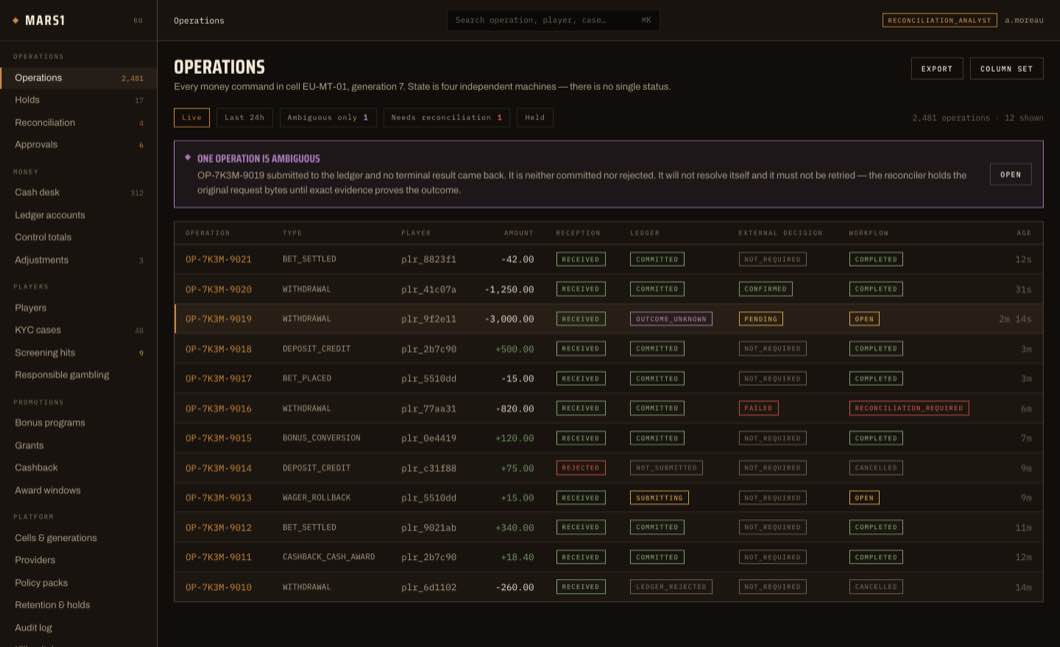
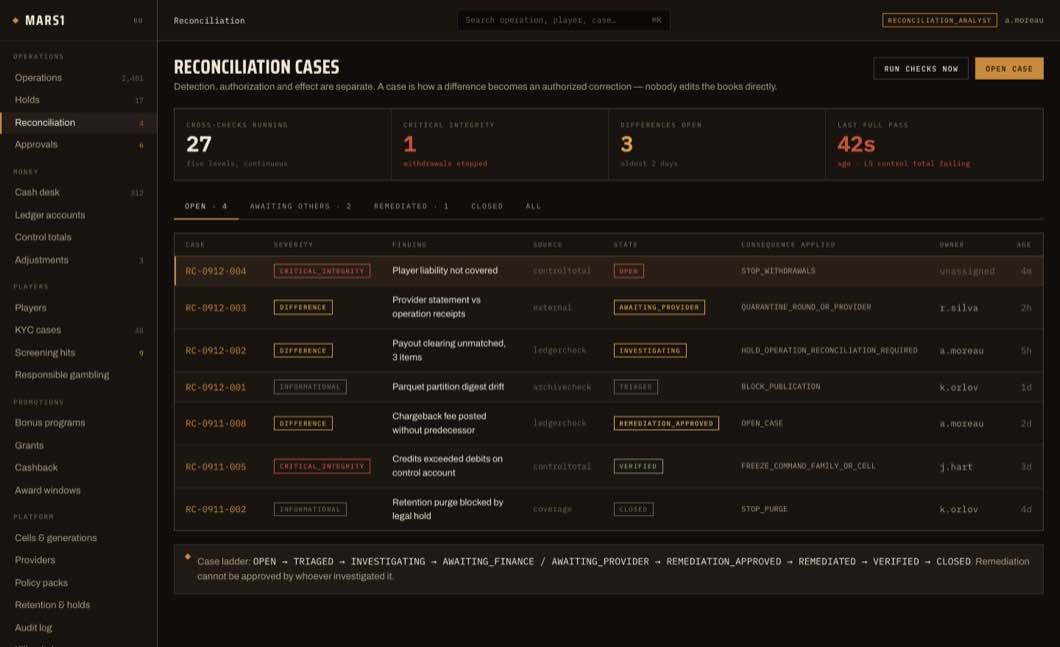
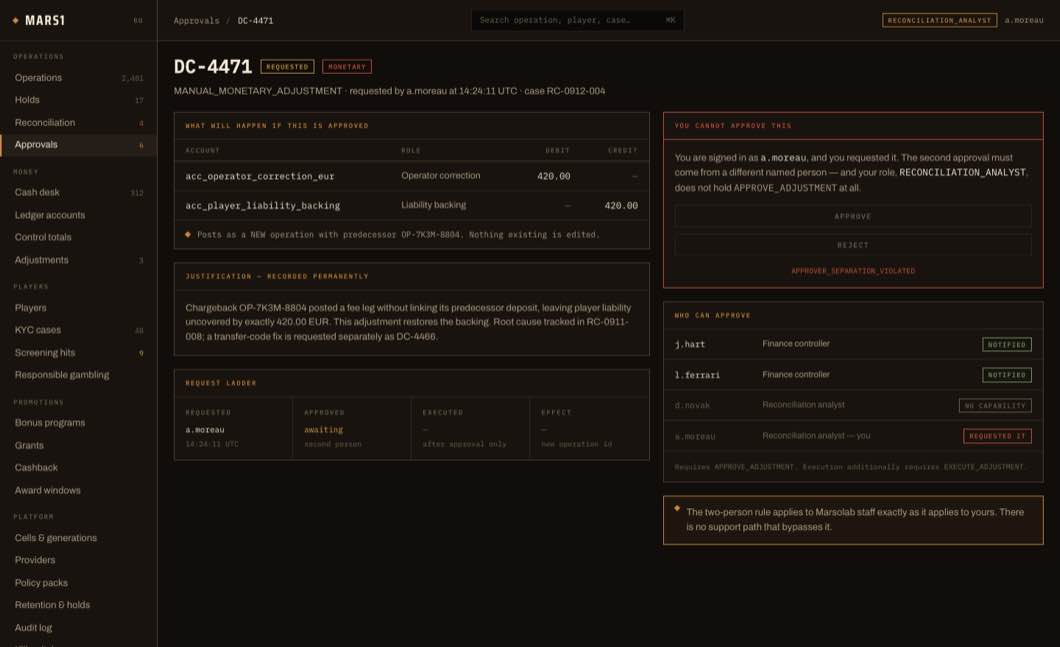
One integration. The whole catalogue.
Slots, live dealer, crash, instant and table games from studios you already know — connected once, managed from one back office. New releases appear without another integration project, and every round is reconciled against the wallet rather than trusted.
Three ways to take it
The platform is the same in all three. What changes is who holds the licence, who runs operations, and how much of your existing stack you keep.
Turnkey
You hold the licence, we run the stack.
For operators who want control without an engineering department.
White Label
Fastest route to a live brand.
For teams with traffic who need a product now.
API & modules
Take only the parts you need.
For platforms that already have a product and one weak layer.
Everyone sells the modules. We can prove the money.
Feature lists in this industry look identical, because they are. The difference shows up on the day a provider callback times out, a bonus gets farmed, or a regulator asks you to show your working.
The system refuses
A payout that would overdraw a balance is rejected by the machine itself. Not by a policy, not by a person — there is no code path that writes it.
Nobody edits the books
There is no set-balance button anywhere, including for us. Corrections are new visible entries, and every risky action needs two named approvers.
Nothing settles twice
A retried request, a dropped connection, a double click — the same round can never charge or pay a player twice, and 27 cross-checks reconcile the books continuously.
Ask your current provider to put that in writing.
The numbers, when we have them
Marked values are placeholders. We publish a number once it is real and sourced — not before. Every operator checks, and a wrong figure costs more than a blank one.
A pilot, not a leap of faith
Three steps with a written pass/fail bar at each one, and you hold the stopwatch. Anything left undefined counts as a no.
Your real numbers
Peak night, markets, payment mix, current pains. Together we write the pilot’s limits down before anything is built.
Beside your stack
Mars1 runs on the same traffic without touching real money. You compare the two side by side, every day.
One market at a time
A capped group of players first, with a daily finance review, widening only when your team says so.
Bring us your busiest night.
Sixty minutes. You bring peak numbers, markets and payment mix. You leave with a pilot plan, written limits and a straight fit or no-fit answer.